















Thank you for your continued support and readership. Please insure to forward this Newsletter to your friends and neighbors. If you no longer wish to receive our emails regarding the update of this page, please send us an email to info@nova-antiques.com with the subject line "OPT OUT"
NOVA-Antiques.com does not run, manage or operate any of the flea markets, auction houses or estate sale companies advertised on this page. The NOVA-Antiques Newsletter is published for the exclusive use, enjoyment and convenience of our readers and subscribers. Any questions regarding the flea markets, auction houses and estate sale companies should be directed to the appropriate owner, promoter or manager.


Duncan Phyfe – The Federal Period
Duncan Phyfe was born in Scotland in 1768 and came to America when he was just sixteen years old. He opened a furniture manufacturing business on Fulton Street in New York City and became of the eras leading furniture makers in
the Country. His furniture mostly followed the designs and artistry of Sheraton and Directoire furniture of previous periods. It was in high demand in industrialized cities such as New York and Philadelphia as well as other large cities where more skilled
workers could afford it.
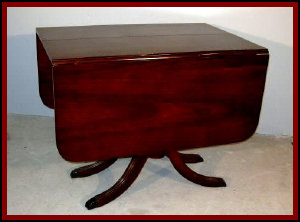
Phyfe favored the use of mahogany woods, mostly from Cuba and Santo Domingo, and rosewood in later years. He used a lot of veneers
as he tried to reproduce the furniture of the earlier periods. Phyfe also liked ornamentation; reeds, lyres and carvings, things
what were learned and borrowed from many of the furniture pattern books of the past. Duncan Phyfe furniture included chairs,
sofas, sideboards but the most familiar to most of us novice collectors is the Duncan Phyfe drop leaf tables.
In the 1970’s, Patricia Nixon, then First Lady of the United States, began decorating several rooms in the White House, including
the Green Room with furnishings and decorations from the 19th Century. Many of the furnishings selected were Duncan Phyfe furnishings. The picture accompanying the previous article on 19th Century furniture is of a Duncan Phyfe table still displayed in the White House
Green Room.
19th Century Antique Furniture
During the Industrial Revolution, beginning in the 19th Century, a lot of changes took place around
the world and America. For the first time, artisans and craftsmen were idled as mass production of household items became more
popular. This included furniture, which up until this point had been handmade and produced by some of the top furniture andcabinetmakers in the world. This led instead to the reproduction, copying and often poorly imitated styles of furniture including
all types of revival; Gothic, Roccoco and Italian. These reproductions contained many elements of gaudy ornamentation, inlay
and carvings and design of the prior periods.
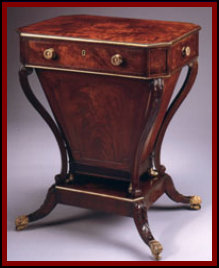
This period in furniture making was not all bad because the mass production of furniture lowered prices and more and more people were
able to afford to decorate and furnish their home. In the 19th Century, skilled workers who previously had to share cramped
spaces were able to move into larger homes. During the Victorian Era, this was mostly done by the wealthy, those who could afford
the furnishings and decorative arts produced by the well known craftsmen and designers. However, mass produced furniture at
the time was considered poorly designed and constructed.
19th Century furniture makers most often copied the styles of Sheraton and Directoire. The Sheraton Style of furniture used
a lot of straight lines with skinny and very plain legged chairs. He also used less inlay and more carvings. The Directoire
style also was very minimal in nature and used much grained veneers and decorative paints. In America, this 19th Century furniture
type of design became known as the Federal Period and one of the main makers was Duncan Phyfe of New York City.


